
Podiatry & Orthotics for Osteoarthritis (OA)
Evidence from Randomised Controlled Trials (RCTs)
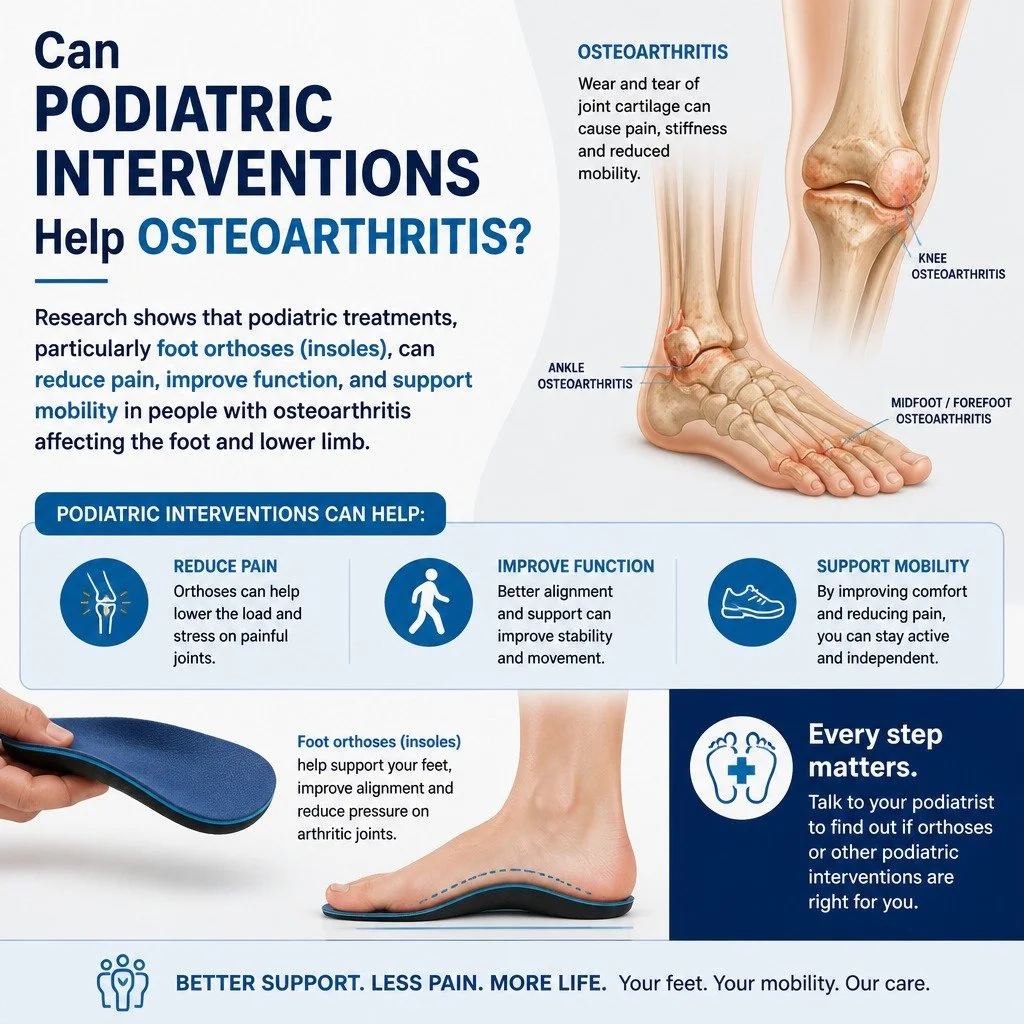
Can Podiatric Interventions Help Osteoarthritis?
Research shows that podiatric treatments, particularly foot orthoses (insoles), can reduce pain, improve function, and support mobility in people with osteoarthritis affecting the foot and lower limb.
Key Research Findings
1. Midfoot Osteoarthritis
Halstead et al., 2016 – Randomised Controlled Trial
Intervention: Functional foot orthoses (customised insoles) vs sham orthoses.
Results:
Greater reduction in foot pain.
Improved foot function.
Better patient-reported overall improvement.
Positive biomechanical changes in foot loading and alignment.
Clinical Message:
Foot orthoses may provide meaningful pain relief and functional improvement in symptomatic midfoot OA.
2. Big Toe Joint Osteoarthritis (1st MTP Joint OA / Hallux Rigidus)
Paterson et al., 2022 – Randomised Controlled Trial
Intervention: Foot orthoses vs sham insoles.
Results:
Significant improvement in OA symptoms.
Reduction in pain during walking and daily activities.
Better overall foot-related outcomes.
Clinical Message:
Appropriately prescribed orthoses can effectively manage painful big toe joint OA.
3. Patellofemoral (Kneecap) Osteoarthritis
Tan et al., 2019 – Randomised Feasibility Trial
Intervention: Foot orthoses vs flat shoe inserts.
Results:
Larger improvements in knee pain.
Improved knee-related quality of life.
Pain reductions exceeded the threshold considered clinically meaningful.
Clinical Message:
Foot orthoses show promise as a conservative treatment option for knee OA.
4. Medial Knee Osteoarthritis
van Raaij et al., 2010 – Randomised Trial
Intervention: Laterally wedged insoles compared with valgus knee braces.
Results:
Pain reduction and functional improvement were achieved.
Insoles provided a safe, low-cost conservative management option.
Clinical Message:
Foot orthoses can be a practical non-surgical treatment for selected patients with knee OA.
What Can a Podiatrist Do for OA?
A podiatrist can provide:
✓ Foot orthoses (custom or prefabricated)
✓ Footwear assessment and advice
✓ Pressure redistribution
✓ Gait analysis
✓ Joint protection strategies
✓ Exercise and self-management guidance
✓ Pain-reducing offloading techniques
Take-Home Message
Evidence from RCTs suggests that podiatric interventions—especially foot orthoses—can:
Reduce pain
Improve walking ability
Improve function and quality of life
Reduce stress on affected joints
Support conservative management of osteoarthritis
Podiatry should be considered as part of a multidisciplinary approach to OA care before progressing to more invasive treatments.
Selected References
Halstead J et al. Foot orthoses in the treatment of symptomatic midfoot osteoarthritis: a randomised feasibility study. Clin Rheumatol. 2016.
Paterson KL et al. Effect of foot orthoses vs sham insoles on first metatarsophalangeal joint osteoarthritis symptoms. Osteoarthritis Cartilage. 2022.
Tan JM et al. The efficacy of foot orthoses in individuals with patellofemoral osteoarthritis: a randomised feasibility trial. Pilot Feasibility Stud. 2019.
van Raaij TM et al. Medial Knee Osteoarthritis Treated by Insoles or Braces: A Randomized Trial. Clin Orthop Relat Res. 2010.